01 Map the tasks before the furniture
List the jobs you perform at home and separate them from work that needs a professional workshop. A tire-pressure check requires a different group of tools from wheel removal or electrical diagnosis. Do not buy a large cabinet to encourage repairs you are not equipped or trained to undertake. Start with the equipment and reference information needed for tasks you can complete correctly.
Mark the parked motorcycle’s footprint, its movement route and the access needed to operate supports. Then add the complete cabinet envelope with drawers open. Check the garage door mechanism, household access and any service panels. Floor space hidden beneath an open drawer is still occupied space, especially when you are carrying a removed wheel or stepping away from a supported bike.
02 Compare storage by constraints
| System | Useful when | Important limitation |
|---|---|---|
| Rolling cabinet | Tools need to move between work positions | Caster behavior, floor joints, stability and drawer loading |
| Fixed cabinet | A permanent storage zone is available | Anchoring instructions and full door or drawer travel |
| Wall panel or rail | Frequently used tools need visible locations | Wall structure, fixing specification and falling-object exposure |
| Portable task box | A small set needs to travel to the bike | Carrying weight, secure closure and clean placement |
A mobile cabinet is convenient only when its route is usable. Small wheels may catch at thresholds or tile joints, while a loaded cabinet can be difficult to control on a slope. Follow the maker’s instructions for moving, braking and opening drawers. Do not assume wheel brakes prevent tipping, or that a stated total capacity can be assigned to any individual drawer.
For fixed or wall-mounted systems, identify the actual substrate before selecting fixings. Plasterboard, masonry and timber structures need different approaches. Hidden services are another reason not to drill casually. Seek competent installation advice when the structure or fixing requirements are uncertain, and avoid placing heavy stored objects above the motorcycle or a normal standing position.
03 Build small, repeatable task groups
Create a routine-inspection group containing the appropriate gauge, light, cleaning materials and model-specific checklist. Keep chain-care items separate from clean measuring instruments. Store wheel-service tools only if you also have the correct support equipment, service information and competence for that work. Label sockets and specialty adapters so similarity does not become a substitute for identification.
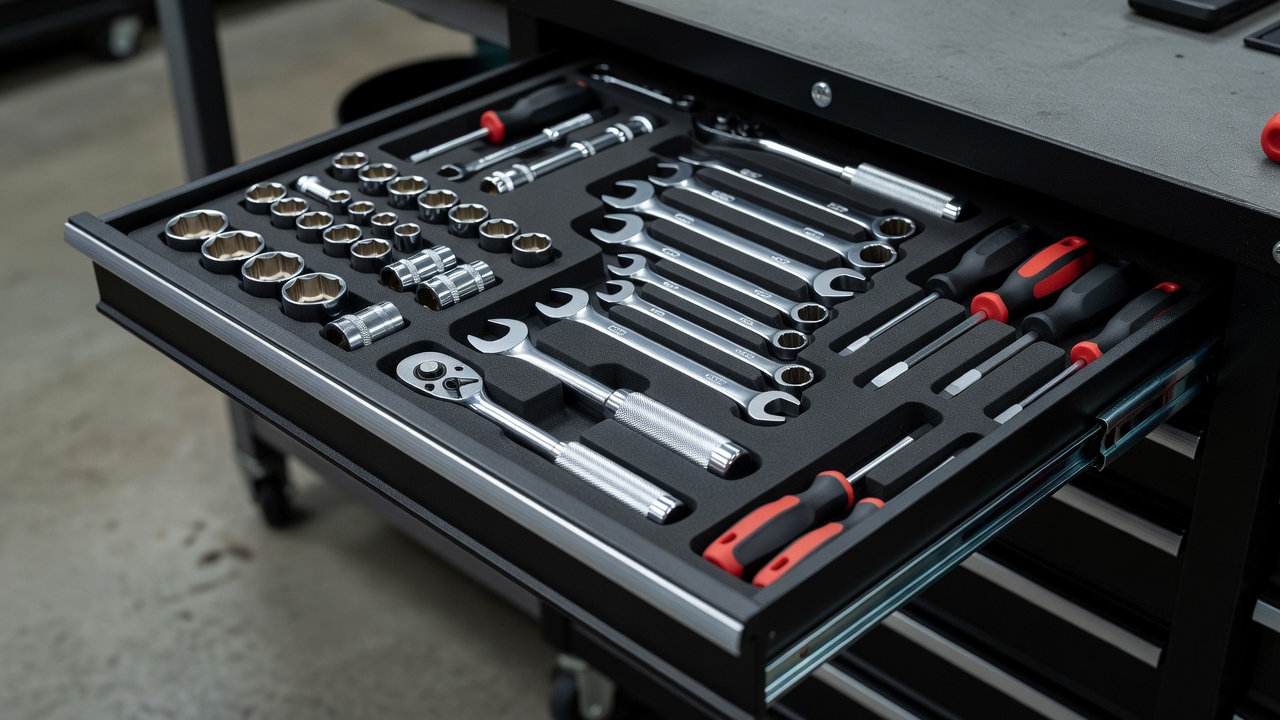
Use shallow organizers to keep small tools visible, but check the drawer’s internal height and clearance before adding inserts. Foam can help reveal a missing item, yet it can also retain dirt or moisture if neglected. A simple tray that is cleaned regularly may be more practical than an elaborate layout that cannot accommodate replacement tools.
04 Protect precision and separate hazards
Torque tools need care according to their own instructions, including storage settings where specified and appropriate calibration or checking arrangements. Do not use a generic storage rule for every mechanism. Keep measuring faces protected and avoid storing precision equipment loose among impact sockets, oily brushes or abrasive materials.
Retain chemicals in suitable, labeled containers and follow their labels, safety data sheets and local storage rules. A standard tool drawer is not automatically appropriate for fuel, solvent-soaked cloths or aerosols. Keep incompatible materials separate and use approved waste arrangements. For general fire-safety background, consult the U.S. Fire Administration and National Fire Protection Association; local rules and the actual product hazards still govern.
05 Treat charging as its own station
Do not hide charging equipment in a closed drawer simply because it makes the workbench look tidy. Follow charger and battery instructions for compatibility, ventilation, spacing and temperature. Keep leads out of the walking route and away from sharp edges, hot parts and moving garage-door components. Stop using damaged cables or equipment and arrange appropriate inspection.
Different battery chemistries and manufacturers have different requirements. A familiar connector does not prove electrical compatibility. Use the motorcycle and battery documentation, and seek qualified advice for unfamiliar systems. A charging location should allow inspection without requiring you to reach behind the motorcycle or move a cabinet while it is connected.
06 Test the system after a real job
Use a small parts tray and label removed fasteners by location. At the end, account for tools and parts before closing drawers. Record unfinished work visibly so a clean bench is not mistaken for a ready-to-ride motorcycle. Adjust the layout when repeated reaching, kneeling or searching shows that frequently used equipment is stored in the wrong place.
For comparison, read actual cabinet documentation from manufacturers such as Bahco, STANLEY and GEDORE. These references are not rankings. Prioritize published drawer capacities, installation instructions, replacement parts and service support over the number of drawers or a matching color scheme.